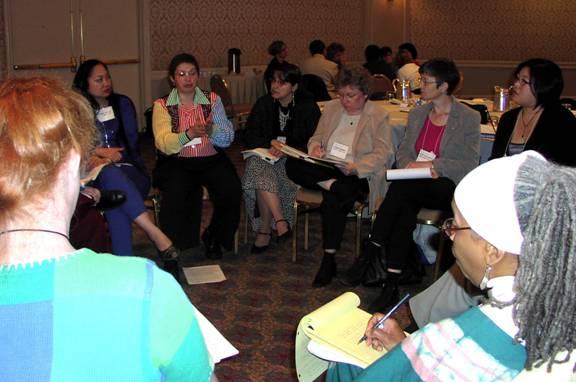
at AERA Chicago 2003
”Language in
Activity from a Cultural Historical Activity Theory (CHAT) and 21st
Century Perspective”
University of California Santa Cruz
Please feel free to browse my webpage:
https://people.ucsc.edu/~gwells/
On it, you will find some of my recent publications. Also, by clicking on the link in the box 'Additional Resources', you will find links to other useful websites.
Educational Studies
University of Michigan
https://www.umich.edu/~jaylemke
Website for students:
https://www-personal.umich.edu/~jaylemke/CHATpage.htm
It has links to my work and other sources of information, mainly on sociocultural and social semiotic theory in relation to CHAT and applications to education, including science education.
My AERA paper on Identity (CH-SIG business meeting with Dorothy Holland) can be found at:
https://www.personal.umich.edu/~jaylemke/papers/Identity/identity_aera_2003.htm
Program in Applied Technology
Adjunct professor
"Technologically Rich Learning Environments"
A syllabus can be found at:
https://www.sinewy.com/CHC/syllabus.html
City of Philadelphia Health Department
Behavioral Health and Mental Retardation Services
Research and Information Management Department
Supervisor for Information on Mental Retardation Services
My web page (outdated) is at:
There is a link to one of my papers (click on "theory") there
as well as a link to a partial listing of my collection of children's metaphors.
University of Pennsylvania
Please consult my webpage for an overview of my research and for
descriptions of relevant publications:
https://www.gse.upenn.edu/~stantonw
University of New Mexico
For my Vygotsky course readings:
www.unm.edu/~hmahn/vygotsky1.html
and for my web site which has some of my publications listed:
Other links:
Mind, Culture, and Activity Website
CHAT-related links from the MCA Website (see the links page for more information and more links)
Cultural-Historical Special Interest group of AERA
Center for Activity Theory and Developmental Work Research
International Society for Cultural
and Activity Research (ISCAR)
5th D Clearinghouse
The Vygotsky Project
Sociocultural Theory
By JAY L. LEMKE
Talking Science: Language, Learning, and Values. Norwood, NJ: Ablex Publishing. 1990.
Textual Politics: Discourse and Social Dynamics. London: Taylor & Francis. 1995.
"Emergent Agendas in Collaborative Activity" Paper presented at American Educational Research Association Annual Meeting, San Francisco (April 1995). _Research in Education_, January 1996. Arlington VA: ERIC Documents Service (ED 386 425), 1996
"Across the Scales of Time: Artifacts, Activities, and Meanings in Ecosocial Systems" Mind, Culture, and Activity 7(4): 273-290. 2000.
“Becoming the Village: Education across Lives” In G. Wells and G. Claxton, Eds. Learning for Life in the 21st Century: Sociocultural Perspectives on The Future of Education. London: Blackwell. pp. 34-45. 2002.
“Language development and identity: multiple timescales in the social ecology of learning.” In C. Kramsch, Ed. Language Acquisition and Language Socialization. London: Continuum. pp 68 – 87. 2002.
“Discursive technologies and the social organization of meaning.” Folia Linguistica 35 (1-2): 79 -96. 2002.
"The Role of Texts in the Technologies of Social Organization." In R. Wodak & G. Weiss, Eds., Theory and Interdisciplinarity in Critical Discourse Analysis. London: Macmillan/Palgrave. 2003.
CHAT & Related PERSPECTIVES ON LANGUAGE IN ACTIVITY (Thanks to Jay Lemke )
Bakhtin, M. 1935/1981. Discourse in the novel. In M. Holquist, Ed. The Dialogic Imagination (1981). Austin TX: University of Texas Press.
Bhabha, H. 1994. The Location of Culture. New York: Routledge.
Bourdieu, P. 1987. Distinction: A Social Critique of the Judgment of Taste. Cambridge, MA: Harvard University Press.
Bourdieu, P. 1990. The Logic of Practice. Stanford CA: Stanford University Press.
Gee, J. P. 1992. The Social Mind. New York: Bergin & Garvey.
Gee, J. P. 2001. “Identity as an Analytic Lens for Research in Education.” In W.G. Secada, Ed., Review of Research in Education 25 (2000-2001). Washington DC: American Educational Research Association.
Halliday, M.A.K. & Martin, J.R. 1993. Writing Science. London: Falmer Press. (U.S.
edition, University of Pittsburgh Press.)
Hasan, R. 1989. The structure of a text. In Halliday, M.A.K. & Hasan, R. Language, Context, and Text. London: Oxford University Press.
Holland, D., Lachicotte, Jr., W., Skinner, D., & Cain, C. (1998). Identity and agency in cultural worlds. Cambridge: Harvard University Press.
Holling, C.S., Gunderson, L. H., & Peterson, G.D. 2002. “Sustainability and panarchies.” In Gunderson & Holling, Eds., Panarchy: Understanding Transformations in Human and Natural Systems. Washington, DC: Island Press.
Latour, B. 1987. Science in action. Cambridge, MA: Harvard University Press.
Latour, B. 1994. On technical mediation. Common Knowledge 3(2): 29-64.
Lave, J. 1988. Cognition in Practice. Cambridge, UK: Cambridge University Press.
Lave, J. & Wenger, E. 1991. Situated learning: legitimate peripheral participation. Cambridge: Cambridge University Press.
Leontiev, A.N. 1978. Activity, consciousness, and personality. Englewood Cliffs, N.J. : Prentice-Hall
Propp, V. 1928. The morphology of the folktale. Austin, TX: University of Texas Press (1968 edition).
Roth, W.-M. 1998. Designing communities. Dordrecht, Netherlands: Kluwer Academic Publishing.
Vygotsky, L. 1934/1963. Thought and Language. Cambridge, MA: MIT Press. (Translation of the Russian original, published 1934.)
Walkerdine, V. 1997. Redefining the subject in situated cognition theory. In D. Kirshner and A. Whitson, Eds., Situated cognition theory: Social, neurological, and semiotic perspectives. Hillsdale, NJ: Erlbaum. Pp. 57-71.
#2 – contributed by Elena Lampert Shepel
Amano, K. (1999) Improvement of schoolchildren’s reading and writing
ability through the formation of linguistic awareness. In Engestrom,Y., Miettinen, R., & Punamaki, R-L.(1999).Perspectives on activity theory. Cambridge:Cambridge University Press, 19-38.
Bakhtin, M.M. (1986). Speech genres and other late essays. Austin, TX
University of Texas Press.
Bakhurst, D. (1991) Consciousness and revolution in Soviet philosophy:
From the Bolsheviks to Evald Ilyenkov. New York, Cambridge
University Press, 59-86.
Bruner, J. (1986). Actual minds, possible worlds. Cambridge, MA:
Harvard University Press.
Bruner, J. (1983). In search of mind. New York: Harper Colophon.
Bruner, J. (1987). Life as narrative. Social Research, 54 (1), 11-32.
Cole, M. (1999). Cultural psychology: Some general principles and a
concrete example. In Engestrom, Y., Miettinen, R., & Punamaki,
R-L. (1999). Perspectives on activity theory. Cambridge, UK:
Cambridge University Press, pp.19-38.
Cole, M. (1986) The zone of proximal development: where culture and
cognition create each other. In Wertsh, J.V.(1986). Culture,
communication, and cognition, Cambridge, Cambridge University Press.
Cole, M. (1990). Cognitive development and formal schooling:
The evidence from cross-cultural research. In Moll, L.C. (1990) Vygotsky and education: instructional implications and applications of sociohistorical psychology. Cambridge: Cambridge University Press.
Davydov, V. (1999). The content and unsolved problems of activity
theory. In Engestrom, Y., Miettinen, R., & Punamaki, R-L.(1999). Perspectives on activity theory. Cambridge, UK: Cambridge University Press, 19-38.
Dewey, J. (1991). How we think. NY: Prometheus Books.
Engestrom,Y. (1999). Activity theory and individual and social
Transformation. In Engestrom, Y., Miettinen, R., & Punamaki, R-
L. (1999). Perspectives on activity theory. Cambridge, UK:
Cambridge University Press, pp.19-38.
Hedegaard, M. (1999) Activity theory and history teaching. In
Engestrom,Y.,Miettinen, R., & Punamaki, R-L.(1999). Perspectives on activity theory. Cambridge: Cambridge, University Press, 19-38.
Geertz, C. (1973). The interpretation of cultures. Basic Books.
Gergen, K.J. (1991). The Saturated Self. Basic Books.
Lompscher, J.(1999) Activity formation as an alternative strategy of
instruction. In Engestrom,Y.,Miettinen, R., & Punamaki, R-L.(1999). Perspectives on activity theory. Cambridge: Cambridge University Press, 19-38.
Minick, N. (1997)The early history of the Vygotskian school: The
relationship between mind and activity. In Cole, M., Engestrom, Y.
& Vasquez, O. (Eds.) (1997) Mind, culture and activity: seminal
papers from the Laboratory of Comparative Human Cognition,
New York: Cambridge University Press.
Moll, L.C. (1990) Vygotsky and education: instructional implications and
applications of sociohistorical psychology. Cambridge: Cambridge University Press.
Panofsky, C., John-Steiner, V. & Blackwell, P.J. The development of
scientific concepts and discourse In Moll, L.C. (1990) Vygotsky
and education: instructional implications and applications of sociohistorical psychology. Cambridge: Cambridge University Press.
Zinchenko, V.P. (1986). Vygotsky’s ideas about units for the analysis of
mind. In Wertsh, J.V.(1986). Culture, communication, and cognition,Vygotskian perspectives.Cambridge, Cambridge University Press.
Wertch, James V. (1985). Vygotsky and the social formation of mind.
Harvard University Press, Cambridge, Massachusetts and London, England.
Wertsch, James V. (1998). Mind as action. New York, Oxford:
Oxford University Press.
Wertsch, J.V. and Stone, C.A. (1986) The concept of internalization in
Vygotsky’s account of the genesis of higher mental functions. In Wertsh, J.V.(1986). Culture, communication, and cognition, Cambridge, Cambridge University Press.
Hits. Created May 8, 2003